|
BUDGET OVERVIEW
The Budget 2023 presented on 1st February 2023, indicates an
extremely cautious approach of the Finance Minister, Ms. Nirmala
Sitharaman’s towards balancing this critical phase of Indian economy.
Indian economy is facing multifaceted
challenges due to soaring inflation and interest rates, post covid
unemployment, rising debt burden &interest payments, international oil
prices, growing borrowings, border tensions, falling rupee value, ethnic
disturbances, frequent elections, deficit on current and capital account,
corruption, banking frauds, black money, international uncertainties,
internal law and order disturbances and high growth {GDP} expectations from
fiscal governance. Further, the issues have become more complex due to lack
of adaptiveness of contemporary and unconventional fiscal tools available
within the country for additional non- tax resource mobilisation. In these
circumstances, our finance minister can definitely be excused for playing
safe in her position.
We wish financial establishment gets more
proactive towards the needs of the time and react muscularly keeping in mind
the aspirations of the public. In view of the media generated publicity
about wastages and misappropriations of public money by some selected class,
the whole governance has been put on public trial. In these circumstances
Regulatory Bodies are required to get into action swiftly and clear the
misgivings and comfort the governance by disciplining the perpetrators.
However, if the government feels that, the
regulatory mechanism and policing are not the solution to the problems like
black money and foreign bank accounts, bank frauds etc. then it should
audaciously look for alternative ways and measures in the larger interest of
the nation without being cautious of political disapprovals. Finance
Minister should realise that, enormous Indian wealth is lying in other
countries which he can attracted discreetly without intimidation. Sometimes
a unassuming fiscal drive can do miracles and eternalise the FM and
governing institution.
Probably, due to the diverse limitations
in the backyard, the vibrancy in the budget speech of 75 minutes of the
Finance Minister is not visible in budget proposals presented in last 18
minutes. Several sectors of national importance which are also large
employment providers such as Black Money, Foreign Bank Accounts, Exports,
Tourism, Arms and Ammunition manufacturing, complex GST Act ,Food Storage,
Research and Development, River and Sea Water Transport etc. do not find any
serious mention in detailed budget documents. The casual and passive
approach will not work out.
Transparency and Accountability are the
biggest hurdles on the way to socio – economic development in this country.
High pitch speeches, promises, manifestos, assertions, inaugurations and
budgets proposals are pleasing for eyes and ears. But in reality, most of
the time, the proposed and delivered benefit does not reach to intended
beneficiary. This needs effective plugging. For bringing all round
transparency in financial transactions and all other actions of the
government the Information and Broadcasting Ministry can develop a
web-portal giving real time information about the actions and performance of
each and every segment of the governance.
The government should proactively support
export of services and commodities. Semi skilled and skilled workers are
cash cows for Indian economy. Government should facilitate Service Exports.
To generate new market for both goods and services our Embassies should hold
regular exhibitions and do everything else necessary for this purpose with
intelligibility and answerability. In fact, these Embassies are generally
white elephants and drain on national resources.
The financial experts at the helm of
Finance Ministry should take note of financial mess in Sri Lanka and
Pakistan. Resource mobilization of 30% of GDP through further borrowing and
interest payment equivalent to almost 20% of the GDP does not sound good.
GDP growth of 6% and current account deficit financing of 5.9% should not
create complacency. In international arenas, we still considered under
developed and net borrower. Resources should be mobilised through
unconventional methods other than borrowings. All religious institutions and
foreign currency account holders can be issued long duration low interest
bonds with transferability feature.
In our country, it is a parliamentary
ritual for every finance minister to deliver vibrant speech loaded with
ornamental fiscal ideas and the best privileged class of Capitalists
immediately reacts with double thumbs – up. One can understand, they have to
live, survive and prosper in this country. Hope one day, the Economic Survey
document will also compulsorily and effectively incorporate schedule of
comparison on proposals versus actual performance and reasons for
variations.
We congratulate the Finance Minister, Ms.
Nirmala Sitharaman for handling a most convoluted economic scenario and
giving us hope of great future for every one of us in this country. We
understand her limitations.
We as countrymen, wish her great success
in all her endeavors while working for the nation. Also, good health and a
long life. May the almighty’s blessings be with her always.
GOVERNMENT’S VISION AND PRIORITIES
The ‘Saptrishi’ priorities of the finance
minister are as follows:
1. Inclusive development
2. Reaching the last mile
3. Infrastructure and investment
4. Unleashing the potential
5. Financial sector
6. Green growth
7. Youth power
The Budget for 2023-24 kept its focus on
expanding Capex for building roads, highways, and railway lines. The middle
class has been given some relief in terms of tweaks in the new income tax
regime. The FM stuck to the fiscal deficit roadmap in the Budget with a
target of 5.9% in FY 24 and adhering to the target for the current. The
middle class has been given some relief in terms of tweaks in the new income
tax regime.
SOME KEY NUMBERS IN FINANCE BILL
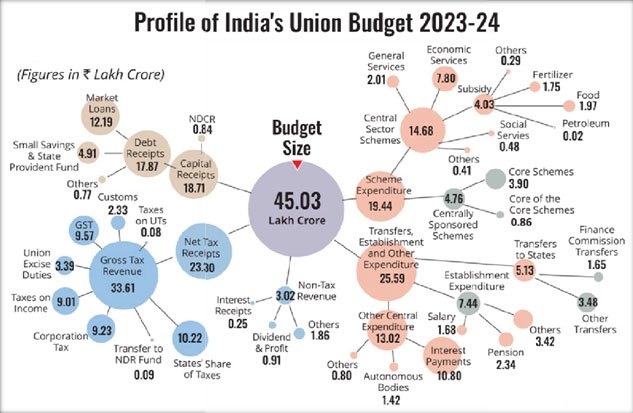
1. Food subsidy seen at 1.97 lakh crore
2. Fertilizer subsidy seen at 1.75 lakh crore
3. Divestment target at Rs 51000 crore
4. Capital expenditure proposed at Rs 10 lkcr, up 33%
5. PM Awas Yojana outlay + by 66% to Rs 79,000 crore.
6. Plan to spend Rs 15000 cr vulnerable tribal group
7. For 3rd phase of e-courts at Rs 7000 crore
8. Rs 35000 crore investment planned in energy security
9. Green Hydrogen Mission aims for output of 5MMT by 2030. Green growth
would be one of the priorities of the budget.
10 .Sugar cooperatives to get benefit of Rs 10,000 crore
11. Import tax on compounded rubber upped to 25% from 10%
12. Calamity related duty on cigarettes raised by 16%
13. The Centre will borrow Rs 15.43 lakh crore via bonds in 2023-24 on a
gross basis, a new all time high.
14. Economy to grow at 7% in the current year.
SPECIFIC SECTORIAL ALLOCATIONS AND
REVIEW
1. Renewable Energy Sector’s allocation is
Rs 7,033 crore a 48% rise in allocation.
2. Ministry of Electronics and Information
Technology has been increased to Rs 16, 549.04 crore from the Rs 11,71 9.95
crore.
3. Allocation for the road transport and
highways ministry has been increase by 36% to around Rs 2.7 lakh crore. NHAI
has been allocated around Rs 1.62 lakh crore as part of capital expenditure
plan for 2023-24.
4. The government announced an 11% hike in
agriculture credit target to Rs 20 lakh crore . The government has also
announced to provide a 2% interest subsidy to ensure farmers get short-term
loans of up to Rs 3 lakh at effective rate of 7% per annum. The RBI has
decided to raise the limit for collateral-free agriculture loans from the
previous ampunt of Rs 1 lakh to Rs 1.6 lakh. Agri credit target increased to
Rs 20 lkcr and Rs 2200 crore for high value horticulture. The target for
agricultural credit has been set at Rs 20 lakh crore for 2023-24. The Union
Government’s focus on reforming the agriculture sector continues, after its
legal reforms had to be repealed. The Budget envisages an open-source
digital infrastructure for agriculture and an agriculture accelerator fund
focused on youth in rural areas. These steps will help the nascent agri-tech
industry and could help boost the sector which still employs nearly half of
the country’s workforce.
5. In Fintech Sector, Digital payments
rose 76% in transaction and 91% in value terms in 2022.
The Fiscal support for digital public
infrastructure (DPI) will continue in 2023- 2024. The scope of documents
available in Digi Locker for individuals will be expanded. An entity Digi
Locker will be set up for use by MSMEs and large businesses. PM VIKAS scheme
will now include access to digital payments and social security. Subsidy for
UPI expected to jump two-folds to Rs 2,137 crore in FY23 over previous
fiscal. Allocation for digital payments promotion remains stagnant at Rs
1500 crore for last three years.
6. Health and family welfare ministry has
been allocated Rs 89, 155 crore, marking a rise of a meagre 12% when
compared to the revised budget estimated for FY 23.
7. Green hydrogen, clean energy storage
and transmission are the key drivers of the government’s “Green Growth”
priority sector.
8. Battery energy storage systems with
capacity of 4,000 MWh will be supported with viability gap funding.
9. A detailed framework for pumped storage
will also be formulated.
10. A green credit programme for
encouraging behavioural change will be notified under the Environment
Protection Act.
11. Mobile phone production in India
increased from 5.8 crore units valued at about Rs 18,900 crore in 2014-15 to
31 crore units valued at Rs 2,75,000 crore in last fiscal year.
12. Centre will spend Rs 2 lakh crore on
free food grains for all priority households under PM Garib Kalyan Yojana.
The Centre will provide free food grains to all antyodaya and priority
households until December 2023.
13. In banking overall bank credit surged
in 2022, with latest RBI data showing non- food bank credit was up 15.3% in
December, up from 9.4% a year ago. However, credit to agriculture and allied
activities was up 11.5% in December, down from 14.2% a year ago. The total
outstanding bank loans to agriculture and allied activities stood at Rs 16.3
lakh crore as on December 30, up Rs 1.69 lakh crore from the end of 2021-22.
14. Relief in custom duty on import of
certain parts of mobile phones like camera lens and batteries by another
year.
15. To provide educational support to 47
lakh youths in 3 years, a Direct Benefit Transfer under a pan India national
apprenticeship scheme will be rolled out.
16. PAN Card will be single business
identification. The move is to allow businesses to use PAN instead of other
data as a unique identifier for entering into the national single-window
system.
17. Budget 2023-24 allocated Rs 79,000
crore for the Pradhan Mantri Awas Yojana, giving a further boost to the
government’s programme to provide housing to the urban poor. The outlay of
PMAY is being enhanced by 66 percent.
18. 157 new nursing colleges will be
established in colocation with the existing 157 medical colleges.
19. The inter-state transmission system
for evacuation and grid integration of 13 GW renewable energy from Ladakh
will be constructed with an investment of Rs 20,700 crore including Central
support of Rs 8,300 crore.
WHAT WILL BE CHEAPER?
Aero planes and other aircrafts; Gold
(including gold plated with platinum) unwrought or in semi- manufactured
forms, or in powder form; Base metals or silver, clad with gold, not further
worked than semi manufactured; New or retreaded pneumatic tyres, of rubber,
of a kind used on aircraft of heading; Platinum, unwrought or in semi
manufactured form, or in powder form; Waste and scrap of precious metal or
of metal clad with precious metal; several aquaculture inputs; Some TV,
camera parts.
IMPORTS TO COST MORE
Vehicle (including electric vehicles);
Silver Dore; Naphtha; styrene, Vinyl Chloride Monomer, Compounded Rubber,
Articles of precious metals, Imitation Jewellery, Electric Kitchen Chimney,
Bicycles, Toys and parts of toys.
SAVINGS AND INVESTMENTS
1. Government to double the deposit limit
for Senior Citizen Savings Scheme to Rs 30 lakh and Monthly Income Account
Scheme to Rs 9 lakh.
2. The government also proposed that the
maximum deposit limit for Monthly Income Account Scheme will be enhanced
from Rs 4.5 lakh to Rs 9 lakh for a single account and from Rs 9 lakh to Rs
15 lakh for a joint account.
3. FM also announced that an integrated IT
portal will be established for investors to reclaim unclaimed shares and
unpaid dividends from the Investor Education and Protection Fund Authority.
PROPOSED AMENDMENTS
IN
FINANCE BILL 2023
PROPOSED AMENDMENTS
The number of amendments seem to look high, but most of these amendments are
procedural.
1. From Section 2 to Section 295 of the
Income Tax Act, 120 of these sections are proposed to be amended by this
finance bill.
2. In Customs, three sections and two
schedules are proposed to be amended.
3. In GST 16 sections are proposed to be
amended
4. Besides above, the finance bill also
proposes amendments in the following six acts.
A. SAVINGS PROMOTION ACT, 1873
B. INDIAN STAMP ACT, 1899
C. SECUTIES CONTRACTS ACT, 1956
D. CENTRAL SALES TAX ACT, 1956
E. BENAMI PROPERTY TRANS. ACT, 1988
F UNIT TRUST OF INDIA ACT, 2002
INDIVIDUALS
PERSONAL TAX RATES ( NEW TAX REGIME )
|
INCOME
(RS) |
PROPOSED
RATES |
UPTO
3,00,000 |
NIL |
3,00,001-6,00,000 |
5% |
6,00,001-9,00,000 |
10% |
9,00,001 –
12,00,000 |
15% |
12,00,001 –
15,00,000 |
20% |
ABOVE
15,00,000 |
30% |
Note – No deduction available except
mentioned below.
• Standard Deduction U/s 16(ia)
• Family Pension U/s 57(iia)
• Deposited in the Agniveer Corpus Fund
u/s 80CCH(2)
OPTION (OLD REGIME) INDIVIDUALS OTHER
THAN SENIOR CITIZEN
|
INCOME
(RS) |
PROPOSED
RATES |
| UPTO 2,50,000 |
Nil |
| 2,50,001-5,00,000 |
5% |
| 5,00,001-10,00,000 |
20% |
| 10,00,001 and above |
30% |
Senior Citizen (Between 60 – 80 years)
|
INCOME
(RS) |
PROPOSED
RATES |
UPTO
3,00,000 |
Nil |
3,00,001-5,00,000 |
5% |
5,00,001-10,00,000 |
20% |
| 10,00,001 and above |
30% |
Super Senior Citizen (Above 80 years)
|
INCOME
(RS) |
PROPOSED
RATES |
| Upto 5,00,000 |
Nil |
| 5,00,001-10,00,000 |
20% |
| 10,00,001 and above |
30% |
Note: Cess of 4% is leviable on the amount
of income tax and surcharge, if any.
Rebate u/s 87A available for a resident
Individual (whose income does not exceed 7,00,000). The amount of rebate is
100% of income tax calculated before education cess or 25000 whichever is
less i.e. no tax under new regime upto Rs. 7 lakhs of Income.
Rebate u/s 87A continues under Old Regime
for a resident individual (whose income does not exceed 5,00,000).The amount
of rebate is 100% of income tax calculated before education cess or 12,500
whichever is less.
SURCHARGE
| Income (Rs) |
Proposed rate of tax
(AY 2024-25) |
Rate of Tax
(AY 2023-24) |
Proposed rate of tax
(AY 2024-25) |
Rate of Tax
(AY 2023-24) |
| New Regime |
Old Regime |
| Upto 50 Lakhs |
Nil |
Nil |
Nil |
Nil |
| 50 Lakhs -1 Crore |
10% |
10% |
10% |
10% |
| 1 Crore- 2 Crore |
10% |
10% |
10% |
10% |
| 2 Crore – 5 Crore |
15%* |
15%* |
15%* |
15%* |
| Above 5 Crore |
25%* |
37%* |
37%* |
37%* |
Surcharge on Dividend income and capital
gains u/s 111A, 112 & 112A will be restricted to 15% only.
CORPORATE TAX RATES
| INCOME |
PROPOSED RATES |
Domestic Company having
total income less than 1 Crore |
30%* |
Domestic Company having
total income more than 1 Crore but less than 10 Crore |
30%* plus surcharge of 7% |
Domestic Company having
total income more than 10 Crore |
30%* plus surcharge of 12% |
Other Company having total
income less than 1 Crore |
40% |
Other Company having total
income more than 1 Crore but less than 10 Crore |
40% plus 2% |
Other Company having total
income more than 10 Crore |
40% plus 5% |
Note: Cess of 4% shall be levied over and
above the above taxes.
*Reduced rate of 25% shall be applicable
where total turnover / receipts in the last P.Y. does not exceed Rs 400 Cr
i. Firms
Flat tax rate of 30% and surcharge @ 12%
of income tax if net income exceeds Rs 1 Cr. Additionally, cess of 4% is
applicable.
ii. Cooperative Societies
| Particulars |
Proposed
Rate |
Having total income of less
than 10,001 |
10% |
Having total income of more
than 10,000 but less than 20,001 |
1,000 plus 20% of total
income in excess of Rs.10,000 |
Having total income of more
than 20,000 |
3,000 plus 30% of total
income in excess of Rs. 20,000 |
Surcharge
Income (Rs) |
Proposed |
Old Rate |
| (AY 2024-25) |
(AY 2023-24) |
| Upto 1 Crore |
Nil |
Nil |
1 Crore- 10
Crore |
7% |
7% |
Above 10
Crore |
12% |
12% |
Additionally, cess of 4% shall be levied.
A co-operative society resident in India
have the option to pay tax at 22%, as per the provision of Section 115BAD,
Surcharge would be at 10% on such tax.
A co-operative society resident in India
have the option to pay tax at 15%, as per the provision of Section 115BAE,
Surcharge would be at 10% on such tax.
TAXATION OF INDIVIDUALS
PROPOSED AMENDMENTS TAX-FREE INCOME
FROM BUSINESS TRUST
Generally, Income earned by Real Estate
Investment Trust and Infrastructure Investment Trust [commonly referred to
as business trusts] are tax free in the hands of the trust and the same is
taxable in the hands of unit holders as a pass-through income unless
specifically exempted. Many times, these business trusts distribute the
income to unit holders which is in the nature of Repayment of debt and the
same will be treated as exempted income which lead to the situation of dual
non-taxation.
In order to curb the said situation, a new provision has been inserted u/s
56(2)(xii) as follows:-
(i) income chargeable to income-tax under
the head “income from other sources” shall also include any sum, received by
a unit holder from a business trust, which-
(a) is not in the nature of income as
referred to in clause (23FC) or clause (23FCA) of section 10 of the Act; and
(b) is not chargeable to tax under
sub-section (2) of section 115UA of the Act;
(ii) where the sum received by a unit
holder from a business trust is for redemption of unit or units held by him,
the sum received shall be reduced by the cost of acquisition of the unit or
units to the extent such cost does not exceed the sum received;
INCOME UNDER LIFE INSURANCE POLICIES
It is proposed to tax income from
insurance policies (other than ULIP for which provisions already exists)
having premium or aggregate of premium above Rs 5,00,000 in a year. Income
is proposed to be exempt if received on the death of the insured person.
This income shall be taxable under the head “income from other sources”.
Deduction shall be allowed for premium paid, if such premium has not been
claimed as deduction earlier. The proposed provision shall apply for
policies issued on or after 1st April 2023.
DOUBLE DEDUCTION ON INTEREST ON
BORROWED CAPITAL FOR PROPERTY
Normally, the amount of any interest
payable on borrowed capital for acquiring, renewing or reconstructing a
property is allowed as a deduction under the head “Income from house
property” under section 24 of the Act.
Many assessees are also claiming double
deduction of interest paid on borrowed capital for acquiring, renewing or
reconstructing a property. Firstly, it is claimed in the form of deduction
from income from house property under section 24, and in some cases the
deduction is also being claimed under other provisions of Chapter VIA of the
Act. Secondly while computing capital gains on transfer of such property
this same interest also forms a part of cost of acquisition or cost of
improvement under section 48 of the Act.
In order to prevent this double deduction, it is proposed to insert a
proviso after clause (ii) of the section 48 so as to provide that the cost
of acquisition or the cost of improvement shall not include the amount of
interest claimed under section 24 or Chapter VIA.
CONTRIBUTION TO AGNIPATH SCHEME AND
WITHDRAWAL
New clause 10(1)(12C) exempts the payment
received from the Agniveer Corpus Fund by a person enrolled under the
Agnipath Scheme, 2022, or their nominee.
New clause 17(1)(ix) provides that the contribution made by the Central
Government to the Agniveer Corpus Fund account shall be considered as salary
of that individual. A corresponding deduction of the same has been provided
as mentioned above.
New Section 80CCH provides that a
deduction of amount deposited by assessee and by the Central Government to
Agniveer Corpus Fund Account, shall be allowed as deduction.
It is to be noted that the above deduction
in respect of Govt contribution is allowed in the New regime. On the other
hand deduction in respect of contribution made by assessee is NOT ALLOWED in
new regime ‘Agnipath scheme’ is defined as a scheme for the enrolment in
Indian Armed Forces introduced by the Central Government, and ‘Agniveer
Corpus Fund’ as a fund defined in para 2(c) of Agnipath Scheme notified by
the Central Government.
TAXATION OF BUSINESS ENTITIES
SET OFF OF LOSS OR UNABSORBED
DEPRECIATION
The amendment made in under section 44BB &
44BBB by inserting a new clause that no set off of unabsorbed depreciation
and brought forward loss of previous year shall be allowed to the assessee
if any assessee declaring his income under provisions of presumptive
taxation.
RELIEF TO SUGAR CO-OPERATIVES
In the case of sugar mill co-operative, by
virtue of amendment made in Finance Act 2015, w.e.f 01.04.2016 the amount
paid for purchase of sugarcane at a price which is equal to or less than the
price fixed by or fixed with the approval of the Government was allowed as
deduction.
New sub-section 155(19) is inserted to
provide that where any deduction in respect of any expenditure incurred for
the purchase of sugarcane has been claimed by an assessee, being a co-
operative society engaged in the business of manufacture of sugar, and such
deduction has been disallowed wholly or partly in any previous year
commencing on or before the 1st day of April, 2014, the Assessing Officer
shall, on the basis of an application made by such assessee in this regard,
recompute the total income of the assessee for such previous year after
allowing deduction to the extent such expenditure is incurred at a price
which is equal to or less than the price fixed or approved by the Government
for that previous year, and the provisions of section 154 shall, so far as
may be, apply thereto, and the period of four years shall be reckoned from
the end of previous year commencing on the 1st day of April, 2022.
EXPENSES PAYABLE TO MSME ALLOWED ON
PAYMENT
In order to promote timely payments to
MSME, a new clause (h) in section 43B is proposed to be added which ensures
that any sum payable by the assessee to a micro or small enterprise beyond
the time limit specified in section 15 of the MSMED Act 2006 shall be
allowed as deduction only on actual payment made during the year only.
Further, the relief of proviso to section 43B of the Act, which related to
payments made on or before the due date of filing of return, shall not apply
to such payments to MSME enterprises.
EXTENSION OF DATE OF INCORPORATION FOR
START- UP
The existing provisions of the section
80-IAC of the Act, inter alia, provides for a deduction of 100% profits and
gains derived from an eligible business by an eligible start-up for 3
consecutive years out of 10 years, from the year of incorporation, at the
option of the assessees subject to the certain conditions.
The sunset clause for incorporation of
such startups is extended by 1 year to 1st April 2024.
FACILITATING CERTAIN STRATEGIC
DISINVESTMENT
To facilitate strategic disinvestment, it
is proposed to provide relaxation in the definition of ‘strategic
disinvestment’ in section 72A as following:
a. The first condition, i.e. reduction of
its shareholding to below 51%, shall apply in case the shareholding was
above 51% before such sale of shareholding.
b. The second condition of requirement of
transfer of control may be carried out by either the Central Government or
State Government or Public Sector Company (or any two of them or all of
them).
Section 72AA of the Act is also amended to
allow carry forward of accumulated losses and unabsorbed depreciation
allowance in the case of amalgamation of one or more banking company with
any other banking institution or a company subsequent to a strategic
disinvestment, if such amalgamation takes place within 5 years of strategic
disinvestment.
CONCESSIONAL TAX FOR NEW MANUFACTURING
CO- OPERATIVE SOCIETY
New Section 115BAE provides for an option
of concessional rate of taxation @ 15% for new manufacturing co-operative
societies registered on or after 01.04.2023, and the co-operative societies
are required to commence manufacturing or production of an article or thing
on or before 31st March 2024.
The conditions are materially similar to
the conditions applicable to new manufacturing companies
Conditions are as follows:
i. the condition for concessional rate
shall be that the total income of the new manufacturing co-operative society
is computed,-
a) without any deduction under the
provisions of section 10AA or clause (iia) of sub-section (1) of section 32
or section 33AB or section 33ABA or sub- clause (ii) or sub-clause (iia) or
sub-clause (iii) of sub-section (1) or sub- section (2AA) of section 35 or
section 35AD or section 35CCC or under any of the provisions of Chapter VI-A
other than the provisions of section 80JJAA;
b) without set off of any loss carried
forward or depreciation from any earlier assessment year, if such loss or
depreciation is attributable to any of the deductions referred to in ii(a)
above; and
c) by claiming the depreciation, if any,
under section 32, other than clause (iia) of sub-section (1) of the said
section, determined in such manner as may be prescribed;
ii. the loss and depreciation referred to
in (ii)(b) above shall be deemed to have been given full effect to and no
further deduction for such loss shall be allowed for any subsequent year.
iii. the concessional rate shall not apply
unless the option is exercised by the person in the prescribed manner on or
before the due date specified under section 139(1) for furnishing the first
of the returns of income for any previous year relevant to the assessment
year commencing on or after 1st day of April, 2024 and such option once
exercised shall apply to subsequent assessment years;
iv. the option so exercised cannot be
withdrawn;
v. if the income of the assessee, includes
any income, which has neither been derived from nor is incidental to
manufacturing or production of an article or thing and in respect of which
no specific rate of tax has been provided separately under this Chapter,
such income shall be taxed at the rate of twenty- two per cent and no
deduction or allowance in respect of any expenditure or allowance shall be
made in computing such income;
vi. where it appears to the Assessing
Officer that, owing to the close connection between the assessee to which
this section applies and any other person, or for any other reason, the
course of business between them is so arranged that the business transacted
between them produces to the assessee more than the ordinary profits which
might be expected to arise in such business, the Assessing Officer shall, in
computing the profits and gains of such business for the purposes of this
section, take the amount of profits as may be reasonably deemed to have been
derived therefrom and such income shall be charged at the tax rate of thirty
per cent.;
vii. in case the aforesaid arrangement
involves a specified domestic transaction referred to in section 92BA, the
amount of profits from such transaction shall be determined having regard to
arm’s length price as defined in clause (ii) of section 92F. The amount,
being profits in excess of the amount of the profits determined by the
Assessing Officer, shall be deemed to be the income of the assessee. The
income-tax payable in respect of the income, in such case shall be computed
at the rate of thirty per cent;
viii. the income-tax payable in respect of
income, being short term capital gains derived from transfer of a capital
asset on which no depreciation is allowable under the Act shall be computed
at the rate of twenty-two per cent;
ix. where the assessee fails to satisfy
the specified conditions under the section in any previous year, the option
shall become invalid in respect of the assessment year relevant to that
previous year and subsequent assessment years and other provisions of the
Act shall apply to the assessee as if the option had not been exercised for
the assessment year relevant to that previous year and subsequent assessment
years.
x. Any machinery or plant which was used
outside India by any other person shall not be regarded as machinery or
plant previously used for any purpose, on fulfilment of certain specified
conditions.
xi. Any machinery or plant or any part
thereof previously used for any purpose is put to use by the assessee and
the total value of such machinery or plant or part thereof does not exceed
twenty per cent of the total value of the machinery or plant used by the
assessee, then, the concessional rate shall apply on fulfilment of the
specified conditions.
xii. The assessee shall not be engaged in
any business other than the business of manufacture or production of any
article or thing and research in relation to, or distribution of, such
article or thing manufactured or produced by it.
LOSSES OF START-UPS TO BE CARRIED
FORWARD FOR 10 YEARS
Proviso to section 79(1) is amended so
that the carried forward loss of eligible start-ups as referred to in
section 80-IAC shall be considered for set off for the period of 10 years
(instead of 7 years earlier) beginning from the year in which such company
was incorporated, if all the shareholders of the company as on the last day
of the year, in which the loss was incurred, continue to hold those shares
on the last day of the previous year in which the loss is set off.
DEDUCTION FOR PRELIMINARY EXPENDITURE
It is proposed to amend section 35D of the
Act to remove the condition of activity in connection with preliminary
expenses to be carried out by a concern approved by the Board. For
allowability of expenses, the assessee shall be required to furnish a
statement containing the particulars of this expenditure within the
prescribed period to the prescribed income-tax authority in the prescribed
form and manner.
THRESHOLD LIMITS FOR PRESUMPTIVE
TAXATION SCHEMES
It is proposed to insert proviso u/s 44AD
whereby the threshold limit is increased to Rs. 3 cr where the cash amount
received during the previous year does not exceed 5% of Total Turnover or
Gross receipt. Further, amount received by cheque or DD which is not account
payee, shall be deemed to be received in cash.
It is proposed to insert proviso u/s 44ADA
whereby the threshold limit is increased to to Rs. 75 Lacs where the cash
amount received during the previous year does not exceed 5% of Total
Turnover. Amount received by cheque or DD which is not account payee, shall
be deemed to be received in cash.
CAPITAL GAIN
LIMITING THE BENEFIT OF SECTION 54 AND
SECTION 54F
In order to prevent the misuse of these
sections, Amendment is proposed in the section 54 and 54F to impose a limit
of capital gain exemption under section 54 and 54F to Rs. 10 cr. Further, if
the cost of the new asset purchased is more than Rs. 10 cr, the cost of such
asset shall be deemed to be Rs. 10 cr. This will limit the deduction under
the two sections to ten crore rupees.
TAXATION OF CAPITAL GAINS IN CASE OF
MARKET LINKED DEBENTURES
Any capital gains arising from the
transfer or redemption or maturity of Market Linked Debentures as short-term
capital gains at the applicable rates, it is proposed to insert a new
section 50AA in the Act to treat the full value of the consideration
received or accruing as a result of the transfer or redemption or maturity
of the “Market Linked Debentures” as reduced by the cost of acquisition of
the debenture and the expenditure incurred wholly or exclusively in
connection with transfer or redemption of such debenture, as capital gains
arising from the transfer of a short term capital asset.
ALIGNMENT OF SECTION 45(5A) WITH THE
TDS PROVISIONS OF SECTION 194-IC
The existing provisions of the sub-section
(5A) of section 45 of the Act, inter alia, provide that on the capital gain
arising to an assessee (individual and HUF), from the transfer of a capital
asset, being land or building or both, under a Joint Development agreement (JDA),
the capital gains shall be chargeable to income-tax as income of the
previous year in which the certificate of completion for the whole or part
of the project is issued by the competent authority. Further, for computing
the capital gains amount on this transaction, the full value of
consideration shall be taken as the stamp duty value of his share, as
increased by the consideration received in ‘cash’.
It has been noticed that the taxpayers are
inferring that any amount of consideration which is received in a mode other
than cash, i.e., cheque or electronic payment modes would not be included in
the consideration for the purpose of computing capital gains chargeable to
tax under sub-section (5A) of section 45. This is not in accordance with the
intention of law as is evident from the provisions of section 194-IC of the
Act which, inter alia, provides that tax shall be deducted on any sum by way
of consideration (other than in kind), under the agreement referred to in
sub-section (5A) of section 45, paid to the deductee in cash or by way of
issue of a cheque or draft or any other mode. Accordingly, it is proposed to
amend the provisions of sub-section (5A) of section 45 so as to provide that
the full value of consideration shall be taken as the stamp duty value of
his share as increased by any consideration received in cash or by a cheque
or draft or by any other mode.
This amendment will take effect from the
1st day of April, 2024 and shall accordingly, apply in relation to the
assessment year 2024- 25 and subsequent assessment years.
CONVERSION OF GOLD TO ELECTRONIC GOLD
RECEIPT AND VICE VERSA
Clause 47(viid) is inserted in order to
exclude conversion of actual gold to Electronic Gold Receipt and vice versa
from definition of transfer which will result in no Capital Gain tax.
The cost of acquisition of the EGR for the purpose of computing capital
gains shall be deemed to be the cost of gold in the hands of the person in
whose name the Electronic Gold Receipt is issued and vice versa.
The holding period for the purpose of
capital gains, would include the period for which gold was held by the
assessee prior to its conversion into EGR. Similarly, provisions for
conversion from gold to EGR are inserted.
INCOME FROM OTHER SOURCES
TAXATION OF WINNINGS FROM ONLINE GAMES
As per the proposed provisions of Section
194BA, any income earned from winnings from online games is liable for
deduction of income- tax at source @ 30% of this Act.
EXPANDING THE SCOPE OF SECTION
56(2)(VIIB)
Earlier, Section 56(2)(viib) of the Act
provides that where a company, not being a company in which the public are
substantially interested, receives, in any previous year, from any person
being a resident, any consideration for issue of shares that exceeds the
face value of such shares, the aggregate consideration received for such
shares as exceeds the fair market value of the shares shall be chargeable to
income-tax under the head ‘Income from other sources’.
Rule 11UA of the Income-tax Rules provides
the formula for computation of the fair market value of unquoted equity
shares for the purposes of the Section 56(2) (viib) of the Act. But, the
provisions are not applicable to consideration received from non-resident
i.e. FDI route.
Now, It is proposed to make the provision
applicable for receipt of consideration for issue of shares from any person
irrespective of his residency status to bring the non resident within the
ambit of section 56(2)(viib) to eliminate the possibility of tax avoidance.
INTERNATIONAL TAXATION
GIFTS RECEIVED BY RNOR
The existing provision of section 9(1)(viii) of the Act relating to
taxability of gifts exceeding fifty thousand rupees, received by a
non-resident without consideration from a person resident in India shall be
income deemed to accrue or arise in India and taxable. The scope of the said
provisions has been extended to Resident and not ordinary residents (RNOR).
In simple words, gifts received by RNOR from India will be taxable.
WITHDRAWAL OF EXEMPTION PROVIDED TO
NEWS AGENCY
As per existing provision under clause
(22B) of section 10 of Income tax act provides exemption to any income of a
notified news agency which is set up in India solely for collection and
distribution of news. The said exemption has been withdrawn w.e.f. 01st
April 2024.
DISTRIBUTED INCOME FROM INTERNATIONAL
FINANCIAL SERVICES CENTRE
The income received by the IFSC Banking
Unit (IBU) from the investments made under the ODI contract is taxed as
capital gains, interest, and dividend. Currently, only the income of non-
residents on transfer of Offshore Derivative Instruments (ODI) is exempt
from tax under section 10 (4E) i.e. Capital gain exempted. However, the
distributed Income, i.e. Interest and dividend, has no such exemption.
Therefore, this income is taxed twice in
India i.e. when it is received by the IBU and then when it is distributed to
the non-resident ODI holders. To prevent double taxation, clause 10 (4E) is
amended to include exemption for the income distributed to the non-resident
ODI holders. In addition to old conditions, this exemption on distributed
income applies only if it is already taxed in the hands of the IFSC Banking
Unit.
NON APPLICABILITY OF THIN
CAPITALIZATION RULES ON NBFCS
It is proposed to amend section 94B(3) so
as to provide that the provision of thin capitalization rules relating to
deductibility of interest shall not apply to such class of NBFCs as may be
notified by the Central Government in the Official Gazette.
TAX TREATY RELIEF AT THE TIME OF TDS
UNDER SECTION 196A
It is proposed to insert a proviso to
section 196A(1) of the Act which seeks to provide that the TDS would be
deducted @20% or the rate or rates provided in the DTAA, whichever is lower,
provided the non- resident furnishes TRC and Form 10F, if applicable.
CHARITABLE TRUST
EXEMPTION TO DEVELOPMENT AUTHORITIES
ETC.
Section 10(46) of the Act provides
exemption to any specified income arising to a body or authority or Board or
Trust or Commission if the said entity is not engaged in any commercial
activity. This restriction on any body or authority or Board or Trust or
Commission has been a litigated issue before the Apex Court.
In view of the observations made by
Hon’ble Supreme Court of India in case of Ahmedabad Urban Development
Authority, and to subdue further litigation, it is proposed to amend the
Act, so as to exclude income of a body or authority or Board or Trust or
Commission, not being a company, from the scope of clause (46) of section 10
of the Act and insert a new clause (46A) in section 10 of the Act for their
income, thereby removing restriction of commercial activity from such
entities.
New clause 10(46A) is also inserted to
exempt any income arising to a body or authority or Board or Trust or
Commission, not being a company, which has been established or constituted
by or under a Central or State Act with one or more of the specified
purposes and notified by the Central Government in the Official Gazette for
the purposes of this clause.
DEPOSITING BACK OF CORPUS AND REPAYMENT
OF LOANS OR BORROWINGS
In order to ensure proper implementation
of both the exemption regimes, it is proposed to provide that application
out of corpus or loans or borrowings before 01.04.2021 should not be allowed
as application for charitable or religious purposes when such amount is
deposited back or invested in to corpus or when the loan or borrowing is
repaid. It is further proposed to provide that if the trust or institution
invests or deposits back the amount in to corpus or repays the loan within 5
years of application from the corpus or loan, then such
investment/depositing back in to corpus or repayment of loan will be allowed
as application for charitable or religious purposes. It is also proposed to
provide that where the application from corpus or loan did not satisfy the
conditions as specified, the repayment of loan or investment/depositing back
in to corpus of such amount will not be treated as application
TREATMENT OF DONATION TO OTHER TRUSTS:
The income of the trusts and institutions
under both regimes is exempt subject to the fulfillment of certain
conditions. Instances have come to the notice that certain trusts or
institutions are trying to defeat the intention of the legislature by
forming multiple trusts and accumulating 15% at each layer. By forming
multiple trusts and accumulating 15% at each stage, the effective
application towards the charitable or religious activities is reduced
significantly to a lesser percentage compared to the mandatory requirement
of 85%.
In order to ensure intended application toward charitable or religious
purpose, it is proposed that only 85% of the eligible donations made by a
trust or institution under the first or the second regime to another trust
under the first or second regime shall be treated as application only to the
extent of 85% of such donation.
VIOLATIONS U/S 12AB & 5TH PROVISO TO
CLA. (23C) OF SECTION 10
It has come to the notice that in some
cases the form furnished by the trusts for provisional approval/registration
and for re-registration/ approval are defective and since the process of
registration/approval/ provisional registration/approval is automated,
registration has been granted by the CPC. At present the
approval/registration and the provisional approval/registration of the
trusts can be cancelled by the PCIT/CIT for certain specified violations.
In order to rationalise the provisions, it
is proposed to, insert clause (g) in Explanation 2 to the fifteenth proviso
of clause (23C) of section 10 of the Act to provide that the “specified
violation” shall also include the case where the application referred to in
the first proviso is not complete or it contains false or incorrect
information.
Similarly, it is proposed to insert clause
(g) in Explanation to sub- section (4) of section 12AB of the Act to provide
that “specified violation” shall also include the case where the application
referred to in clause (ac) of sub- section (1) of section 12A of the Act is
not complete or it contains false or incorrect information.
ALIGNMENT OF THE TIME LIMIT FOR
FURNISHING THE FORM FOR ACCUMULATION OF INCOME AND TAX AUDIT REPORT
The due date for furnishing form 9A and
form 10 is same as the due date of furnishing the return of income. The
trusts are also required to furnish audit report in form 10B/10BB one month
before the due date for furnishing return of income. The auditors are
required to report the details of form 10/9A in the audit report. Since the
due date for furnishing form 9A/10 is one month before the due date of
furnishing the ITR, auditors find it difficult to report.
In order to rationalise the provisions, it
is proposed to provide for filing of Form No. 10A/9A at least two months
prior to the due date specified under sub-section (1) of section 139 for
furnishing the return of income for the previous year. Necessary amendments
in this regard are proposed in,
a) clause (c) of Explanation 3 to third
proviso of clause (23C) of section 10 of the Act;
b) clause (2) of Explanation 1 sub-section
(1) of section 11 of the Act;
c) clause (c) of sub-section (2) of the
said section 11 of the Act.
DENIAL OF EXEMPTION WHERE RETURN OF
INCOME IS NOT FURNISHED WITHIN TIME
As per the provisions of twentieth proviso
to clause (23C) of section 10 of the Act, if the return of income is not
furnished by a trust or institution under first regime within the time under
section 139 of the Act, exemption under sub-clause (iv)/(v)/(vi)/(via) of
clause (23C) of section 10 of the Act shall not be available to such trust
or institution.
a. Similarly, as per the provisions of
clause (ba) of sub-section (1) of section 12A of the Act, if the return of
income is not furnished by a trust or institution under the second regime
within the time under section 139 of the Act, exemption under section 11, 12
of the Act shall not be available to such trust or institution.
b. Section 139 of the Act was amended by
the Finance Act, 2022 providing for an option to the taxpayers to furnish
updated return of income up to 2 years from the end of assessment year.
c. This resulted in unintended
consequences of allowing exemption under section 11, 12 of the Act and
sub-clause (iv)/(v)/(vi)/(via) of clause (23C) of section 10 of the Act will
be available to the trusts where they furnish updated return of income.
Accordingly, it is proposed to clarify that the exemption under section 11,
12 and sub-clause (iv)/(v)/(vi)/(via) of clause (23C) of section 10 of the
Act will be available only if the return of income has been furnished within
the time allowed under sub-section (1) or sub- section (4) of section 139 of
the Act.
TAX ADMINISTRATION AND COMPLIANCE
NEW PROVISION FOR INVENTORY VALUATION
In order to ensure that the inventory is
valued in accordance with various provisions of law, it is proposed to amend
section 142 of the Act relating to Inquiry during assessment.
If, at any stage of the proceedings before
him, the Assessing Officer, having regard to the nature and complexity of
the accounts, volume of the accounts, doubts about the correctness of the
accounts, multiplicity of transactions in the accounts or specialised nature
of business activity of the assessee, and the interests of the revenue, is
of the opinion that it is necessary so to do, he may, with the previous
approval of the Principal Chief Commissioner or Chief Commissioner or
Principal Commissioner or Commissioner, direct the assessee to get either or
both of the following, namely:––
(i) to get the accounts audited by a CA,
nominated by the Principal Chief Commissioner or Chief Commissioner or
Principal Commissioner or Commissioner in this behalf and to furnish a
report of such audit in the prescribed form duly signed and verified by such
accountant and setting forth such particulars, as may be prescribed, and
such other particulars as the Assessing Officer may require;
(ii) to get the inventory valued by a cost
accountant, nominated by the Principal Chief Commissioner or Chief
Commissioner or Principal Commissioner or Commissioner in this behalf and to
furnish a report of such inventory valuation in the prescribed form duly
signed and verified by such cost accountant and setting forth such
particulars, as may be prescribed, and such other particulars as the
Assessing Officer may require:
Provided that the Assessing Officer shall
not direct the assessee to get the accounts so audited or inventory so
valued unless the assessee has been given a reasonable opportunity of being
heard.
WITHHOLDING OF REFUNDS IN CERTAIN CASES
Section 245 is substituted, so as to
provide that where under any of the provisions of this Act, a refund is due
to any person, the Assessing Officer or Commissioner or Principal
Commissioner or Chief Commissioner or Principal Chief Commissioner, may, in
lieu of payment of the refund, set off the amount to be refunded or any part
of that amount, against any sum remaining payable under this Act by the
person to whom the refund is due, after giving an intimation in writing to
such person of the action proposed to be taken under this section.
Where art of the refund has been set off
under above provision or where no amount is set off, and refund becomes due
to a person, then, the Assessing Officer, having regard to the fact that
proceedings of assessment or reassessment are pending in such case and grant
of refund is likely to adversely affect the revenue, and for reasons to be
recorded in writing and with the previous approval of the Principal
Commissioner or Commissioner, may withhold the refund till the date on which
such assessment or reassessment is made.
SECTION 241A IS MADE INAPPLICABLE FROM
1ST APRIL, 2023.
Further, as the amendments proposed under
section 245 would have an impact on cases referred to in section 244A(1A),
i.e., where refund due to the assessee is required to be withheld by the AO
under sub-section (2) of the proposed section till the date of the making
assessment or reassessment, it is proposed to amend section 244A(1A) by
inserting a proviso that in case of an assessee where proceedings for
assessment or reassessment are pending, the additional interest shall not be
payable to the assessee under this subsection, for the period beginning from
the date on which such refund is withheld by the Assessing Officer, in
accordance with and subject to provisions of sub-section (2) of section 245,
till the date on which the assessment or reassessment pending in such case,
is made.
However, the proposed amendment shall not
impact the existing position with regard to all other types of interest,
except additional interest under sub-section (1A) of section 244A, payable
to the assessee as required under the Act.
INTEREST U/S 234B WHILE FILING UPDATED
RETURN
It is proposed to amend section 140b(4) to
provide that interest payable under section 234B for updated return, shall
be computed on an amount equal to the assessed tax as reduced by the amount
of advance tax, the credit for which has been claimed in the earlier return,
if any.
TIME LIMIT FOR RECTIFICATION BEFORE
BOARD OF SETTLEMENT
The Finance Act, 2021 abolished the
Settlement Commission w.e.f. 01.02.2021 and the Central Government was
empowered to constitute one or more Interim Boards for Settlement (IBS) but
the same was constituted on 10.08.2021. As an interim measure, for
settlement of applications pending with Settlement Commission as on
31.01.2021 was to be dealt at IBS.
Section 245D(9)(iv) provides that where
the time-limit for amending any order or filing of rectification application
as per sub-section (6B) expires on or after 01.02.2021, then the period from
01.02.2021 till the constitution of IBS shall be excluded from computing the
time- limit, and after such exclusion, if the time-limit available for
amending the order or for making application is less than 60 days, such
period shall be extended to 60 days. Therefore, as per the provisions of
Section 245D(9)(iv), the period between 01.02.2021 till 10.08.2021 (when the
order constituting IBS was issued) shall be excluded for computing the
time-limit.
There was huge pendency before IBS as on
date. In order to provide time to IBS, it proposed to be substituted with a
new clause to provide that where the time-limit for amending an order or for
making an application expires on or after 01.02.2021 but before 01.02.2022,
then such time-limit shall stand extended to 30.09.2023.
NEW AUTHORITY OF JOINT COMMISSIONER
(APPEALS) FOR SMALL APPEALS
At present, all CIT (Appeals) are
overburdened due to the huge number of appeals and the pendency being
carried forward every year. In order to clear this bottleneck, a new
authority for appeals is being proposed to be created at JCIT/ Add CIT level
to handle certain class of cases involving small amount of disputed demand.
Such authority will have all powers, responsibilities and accountability
similar to that of Commissioner (Appeals) with respect to the procedure for
disposal of appeals. But, an appeal cannot be filed before the JCIT
(Appeals) where an order is passed by or with the approval of an income-tax
authority above the rank of DCIT.
For all pending appeals before CIT(A), the
CBDT or an income-tax authority so authorised by the CBDT in this regard,
may transfer such appeal and any matter arising out of or connected with
such appeal and which is so pending, to the JCIT(Appeals) who may proceed
with such appeal or matter, from the stage at which it was before it was so
transferred.
Further, the CBDT or an income-tax
authority so authorised by the Board in this regard, may transfer any appeal
which is pending before a JCIT(Appeals) and any matter arising out of or
connected with such appeal and which is so pending, to the CIT(Appeals) who
may proceed with such appeal or matter, from the stage at which it was
before it was so transferred.
In case of transfer of appeal from CIT(A)
to JCIT(A) or vice versa, the appellant shall be provided an opportunity of
being reheard. The complete scheme in this regard will be notified by CBDT.
REDUCING THE TIME PROVIDED FOR
FURNISHING TP REPORT
During TP Assessment, TPO is required to
provide the 30 days time to the assessee from the date of receipt of a
notice issued for submission the TP Study document prepared as per Rule 10D
of Income Tax Rules 1962. The said time period may further, on an
application made by the assessee, be extended by an additional period of 30
days.
It is proposed to reduce the time period from 30 days to 10 days and the
further extension can be given for a period not exceeding thirty days.
RATIONALISATION OF APPEALS TO ITAT
Normally, Penalty under sections 271AAB,
271AAC and 271AAD are levied by the AO. But, Finance Act, 2022, has given
the said power to CIT (Appeals) also to pass an order imposing penalty under
the said sections. But, an aggrieved assessee cannot appeal against such
penalty orders passed by CIT(Appeals) i.e. the said order was un-appealable.
Therefore, it has been proposed to amend the provisions of section 253 of
the Act to provide that appeal against penalty orders passed by CIT(Appeals)
u/s 271AAB, 271AAC and 271AAD shall be made to ITAT.
Similarly, now appeal against an order
passed under section 263 of the Act by Principal Chief Commissioner or Chief
Commissioner or an order passed under section 154 of the Act in respect of
any such order shall also be made to ITAT. Earlier, the a memorandum of
cross-objections before ITAT can be filled only in the case of appeal
against the order of CIT(A). Now, amendment has been proposed to enable
filing of memorandum of cross-objections in all classes of cases against
which appeal can be made to ITAT.
ASSISTANCE TO AUTHORISED OFFICER DURING
SEARCH AND SEIZURE
During the course of search, the
authorised officer may requisition the services of any police officer or any
officer of the Central Government, to assist him for any of the actions
required to be performed during the course of such search, and it shall be
the duty of such officer to comply. Further, the authorised officer may make
a reference to a valuation officer for estimating the fair market value of
the property and such reference can be made during the search or within 60
days from the date of executing the last authorisation for search.
The authorized officer often required the
help of expert/ professional for valuation of undisclosed assets and
decryption of information often require specific domain experts like digital
forensic professionals, valuers, archive experts etc. In addition to this,
services of other professionals like locksmiths, carpenters etc. are also
required in most of the cases, due to typical nature of the operations.
Therefore, it is proposed to amend
relevant provisions of the section to provide that during the course of
search the authorised officer, may requisition the services of any other
person or entity, as approved by the PCCIT or the CCIT, in accordance with
the procedure prescribed by the Board in this regard, to assist him for the
purposes of the search either during the search or post search.
AUTHORISATION FOR SEARCH
The timelines for completing assessment or
reassessment in search cases is linked to the execution of the last of the
authorisations during such procedure, in order to establish the day of
conclusion of search proceedings, and what constitutes as last authorisation
is provided in section 153B. As the provisions of section 153B are no longer
applicable, it is proposed to provide the meaning of execution of last
authorisation under section 132 itself as under:-
The last of authorisation for search shall
be deemed to have been executed,––
(a) in the case of search, on the
conclusion of search as recorded in the last panchnama drawn in relation to
any person in whose case the warrant of authorisation has been issued;
or
(b) in the case of requisition under
section 132A, on the actual receipt of the books of account or other
documents or assets by the authorised officer.
PROVISIONS RELATED TO BUSINESS
REORGANIZATION
Section 170A of the Act was inserted vide
Finance Act, 2022 in order to make provisions for giving effect to the order
of business reorganization issued by tribunal or court or an Adjudicating
Authority under the Insolvency and Bankruptcy Code, 2016. But, there was no
prescribed procedure to be followed by the Assessing Officer after the
modified return is furnished by the successor entity.
Now, It is being provided that, if
proceedings of assessment or reassessment for the relevant assessment year
have been completed on the date of furnishing of modified return, the
Assessing Officer shall pass an order modifying the total income of the
relevant assessment year in accordance with the order of the business
reorganisation and taking into account the modified return so furnished.
Where proceedings of assessment or
reassessment for the relevant assessment year are pending on the date of
furnishing of modified return, the Assessing Officer shall pass an order
assessing or reassessing the total income of the relevant assessment year in
accordance with the order of the business reorganisation and taking into
account the modified return so furnished.
INCREASE IN TIME-LIMIT FOR ASSESSMENT
The time available for completion of
assessment relating to the assessment year commencing on or after the 1st
day of April, 2022 shall be 12 months from the end of the assessment year in
which the income was first assessable. The time available for completion of
assessment proceedings in the case of an updated return is also proposed to
be increased to 12 months from the end of the financial year in which such
return is furnished.
Increased time limit of 12 months has been
proposed by inserting 153(3A) to provide that where an assessment or
reassessment is pending on the date of initiation of search under section
132 or making of requisition under section 132A, the period available for
completion of assessment or reassessment, as the case may be, under the said
sub-sections (1), (1A), (2) and (3) of the said section, shall be extended
by 12 months in a case of an assessee where such search is initiated under
section 132 or such requisition is made under section 132A or in the case of
an assessee to whom any money, bullion, jewellery or other valuable article
or thing seized or requisitioned belongs to or in the case of an assessee to
whom any books of account or documents seized or requisitioned pertains or
pertain to, or any information contained therein, relates to.
PROVISIONS RELATING TO REASSESSMENT
PROCEEDINGS
Return in response to a notice under
section 148 of the Act shall be furnished within three months from the end
of the month in which such notice is issued, or within such further time as
may be allowed by the Assessing Officer on a request made in this behalf by
the assessee. However, any return which is furnished beyond the period
allowed in the section 148 to furnish such return of income shall not be
deemed to be a return under section 139 of the Act. As a result, the
requirement of issuing notice u/s 143(2) would not be mandatory for such
returns.
A new proviso has been inserted to section
149 to provide that in cases where a search under section 132 is initiated
or a search for which the last of the authorization is executed or
requisition is made under section 132A, after the 15th March of any
financial year a period of 15 days shall be excluded for the purpose of
computing the period of limitation for issuance of notice under section 148
and the notice so issued shall be deemed to have been issued on the 31st day
of March of such financial year.
Further, another proviso in the section
149 of the Act has also been inserted to provide that in cases where the
information deemed to be with the Assessing Officer emanates from a
statement recorded or documents impounded under summons or survey, as the
case may be, on or before the 31st day of March of a financial year, in
consequence of, a search initiated or last of the authorization executed
under section 132 or a requisition made under section 132A, after the 15th
day of March of such financial year, a period of 15 days shall be excluded
for the purpose of computing the period of limitation for issuance of notice
under section 148 and the show cause notice issued u/s 148A(b) in such case
shall be deemed to have been issued on the 31st day of March of such
financial year.
PENALTY
PENALTY FOR CASH LOAN/ TRANSACTIONS
AGAINST PRIMARY CO- OPERATIVES
A proviso is inserted in both Section
269SS and Section 269T to increase threshold limit from Rs. 20,000 to Rs.
2,00,000 from imposition of penalty in the case of primary agricultural
credit society (PACS) and a primary co-operative agricultural and rural
development bank (PCARD). Therefore, where
1. a deposit is accepted by
2. a loan is taken from
3. a deposit is paid by
4. a loan is repaid to from/by its members
does not exceeds Rs. 2,00,000, the penalty would not be leviable.
NEW PENALTY U/S 271FAA
New penalty of Rs. 5,000 shall be
imposable if there is any inaccuracy in the statement of financial
transactions submitted by a prescribed reporting financial institution and
such inaccuracy is due to false or inaccurate information submitted by the
account holder, in addition to any other penalty leviable on such financial
institution, if any.
TAX DEDUCTION AT SOURCE
TDS ON PAYMENT OF INTEREST ON LISTED
DEBENTURES
Now, TDS needs to be deducted u/s 193 of
the Act on Interest payment on debentures issued by a company which is
listed in Indian stock exchange of India and payment made to Resident of
India.
TDS AND TAXABILITY ON NET WINNINGS FROM
ONLINE GAMES
As per previous provisions of section 194B
& 194BB of this act , deductors are required to deduct tax under section
194B and 194BB of the Act if payment made is more than Rs 10,000/- per
transaction. Now, as per amendment made in section 194B & 194BB, TDS should
be deducted in case of single payment or aggregate of payments made exceeds
Rs. 10,0000 during the financial year. Gambling or betting of any form or
nature has also been included within the scope of Section 194B.
New section 194BA has inserted for
deduction of TDS on net winnings from online games from user account at the
end of the financial year or at the time of withdrawal of money, whichever
earlier. The special rate of tax @ 30% on income by way of winning from
online games has been introduced u/s 115BBJ.
INCREASING RATE OF TCS FOR FOREIGN
REMITTANCES
| S. No. |
Type of remittance |
Present rate |
Proposed rate |
| (i) |
For the purpose of any education, if
the amount being remitted out is a loan obtained from any financial
institution as defined in section 80E. |
0.5% of the amount or the aggregate of
the amounts in excess of Rs. 7 lakh. |
No change. |
| (ii) |
For the purpose of education, other
than (i) or for the purpose of medical
treatment. |
5% of the amount or the aggregate of
the amounts in excess of Rs. 7 lakh. |
No change. |
| (iii) |
Overseas tour package |
5% without any threshold limit. |
20% without any threshold limit. |
| (iv) |
Any other case |
5% of the amount or the aggregate of
the amounts in excess of Rs. 7 lakh. |
20% without any threshold limit. |
INCREASING THRESHOLD LIMIT FOR
CO-OPERATIVES TO WITHDRAW CASH WITHOUT TDS
Section 194N of the Act provides that a
banking company or a banking co-operative society or a post office, while
paying sum aggregating to above 1 Cr during the year, shall deduct 2% of
such aggregated sum, as income-tax.
However, in case of a recipient, who is a
non-filer, TDS is to be deducted at the rate of 2% on any sum exceeding Rs.
20 lakh but not exceeding Rs. 1 crore in aggregate during the year and, at
the rate of 5% on sum exceeding Rs. 1 crore in aggregate during the year.
A new proviso is inserted to provide that
where the recipient is a co- operative society, the threshold of 1 Cr shall
be increased to 3 Cr in case of filers and non-filers which can be
summarised as under:
TDS CREDIT OF INCOME DECLARED IN PAST
YEARS
Generally, in case of government
contractors, TDS is deducted on payment basis but the income was declared by
the contractor on due basis. TDS is deducted at the time of payment which is
in subsequent years only. There is a big problem about the allowability of
TDS credit in subsequent years.
In order to remove this difficulty, it is
proposed to insert a new section 155(20) which applies where any income has
been included in the return of income furnished by an assessee under section
139 of the Act for any assessment year (hereinafter referred to as the
“relevant assessment year”) and tax has been deducted at source on such
income and paid to the credit of the Central Government in accordance with
the provisions of Chapter XVII-B in a subsequent financial year. In such a
case, the assessee can make an application in the prescribed form to the
Assessing Officer within two years from the end of the financial year in
which such tax was deducted at source. Then, the Assessing Officer shall
amend the order of assessment or any intimation allowing credit of such TDS
in the relevant assessment year.
It has been further provided that the
provisions of section 154 of the Act shall also apply in this case and the
period of four years shall be reckoned from the end of the financial year in
which such tax has been deducted.
Amendment has also been proposed in
section 244A of the Act to provide that the interest on refund arising out
of above rectification shall be for the period from the date of the
application to the date on which the refund is granted.
MISCELLANEOUS AMENDMENTS
RATIONALIZATION OF THE PROVISIONS OF
THE PROHIBITION OF BENAMI PROPERTY
Under the existing provisions of section
46 of the PBPT Act, any person, including the Initiating Officer (IO),
aggrieved by the order of the Adjudicating Authority, may prefer an appeal
to the Appellate Tribunal within a period of 45 days from the date of the
order. The order often takes time to reach the office of the Initiating
Officer or the approving authority and, it is difficult to file an appeal
within the prescribed time limit and leads to delay in such filing.
Now, the time limit of 45 days will start
from the date when such order is received in the office of the Initiating
Officer or the aggrieved person as the case may be.
|
CA A. K. JAIN
TAPURIAH JAIN & ASSOCIATES
CHARTERED ACCOUNTANTS
OFFICE: 21, SKIPPER HOUSE, 9, PUSA ROAD
NEW DELHI-110005.
EMAIL:
CAINDIA@HOTMAIL.COM
WEB:
WWW.TJAINDIA.COM
CONTACT: +91-9810046108
|
|