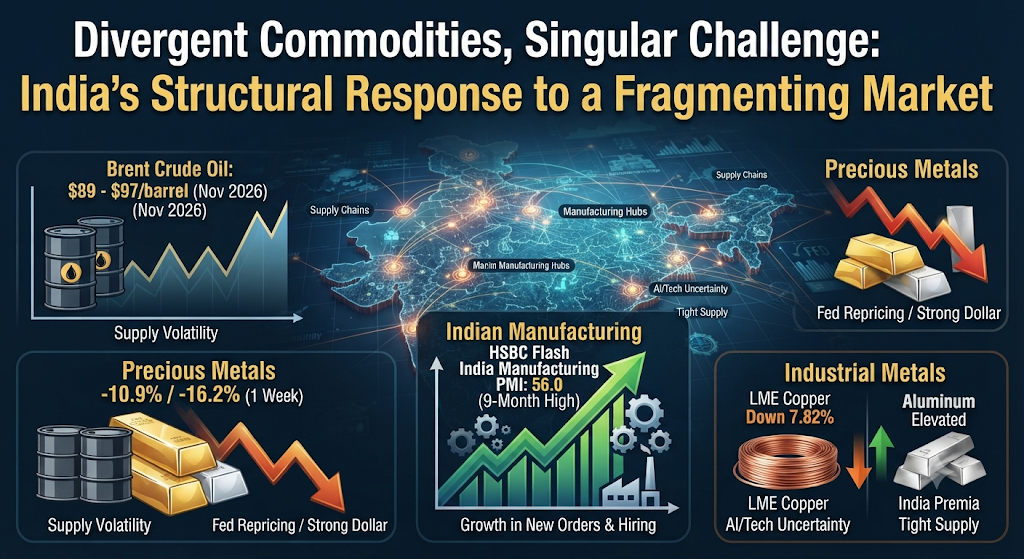
The November 2026 data confirms that the adjustment is neither orderly nor uniform. Brent crude oscillated between roughly $89 and $97 per barrel during the month, settling near $92 by mid-November as supply-side recovery competed with persistent geopolitical risk premia. The precious metals rout was far more violent: MCX gold futures plunged 10.9% in a single week to ₹1,21,778 per 10 grams, while silver collapsed 16.2% to ₹1,47,813 per kilogram, driven by a hawkish Federal Reserve repricing and a surging dollar. Industrial metals diverged internally as well—LME copper fell 7.82% week-on-week to $12,526 per tonne amid technology-sector uncertainty and AI investment doubts, yet aluminium physical premiums in India remained elevated at MCX plus ₹14–15 per kilogram against ₹3–4 earlier, reflecting tight spot availability and backwardation. This is not a commodity cycle; it is a repricing of risk across asset classes in response to monetary tightening, sectoral shifts, and supply-chain fragmentation.
For India, the manufacturing sector provides a countervailing signal. The HSBC Flash India Manufacturing PMI rose to a nine-month high of 56.0 in November, supported by stronger new orders, output, and the fastest hiring pace in seven months. This momentum creates a narrow window. Lower input costs from softening copper and energy prices could ease margin pressure, but only if firms capture those gains before volatility returns. The risk is that commodity swings—rather than productivity gains—dictate profitability, investment cycles, and employment. Converting temporary relief into durable competitiveness requires targeted interventions: hedging frameworks for small and medium manufacturers, accelerated domestic processing capacity for critical metals, and energy diversification that reduces the pass-through of Brent shocks to industrial costs.
Conclusion
India’s long-term economic trajectory will not be determined by whether copper rebounds or crude retreats. It will be determined by how effectively the economy decouples its industrial ambitions from the whims of global commodity markets. The November turbulence is a reminder that resilience is not a passive condition—it is built through deliberate policy, infrastructure, and institutional design. A rapidly developing economy seeking sustained employment and higher living standards must treat commodity volatility as a structural constraint to be engineered around, not a temporary inconvenience to be endured. The adjustment is complex; the response must be strategic.

R231126